couch

couch

Tuesday, 12 November 2013

The Important Book by Margaret Wise Brown and Leonard Weisgard

We love this book. First spotted on a Dinner a Love Story post about great presents to give a new baby, I thought I should get it quick before my son got any older. It turned out that it is the kind of book that grows with them - he is three now and I can see we'll be plucking this from the shelf for quite a while. Also, his older brothers have all taken an interest in it.


What the author does is take some simple things a child encounters most days; apples, shoes, the sky, a flower and writes what she thinks is important about it. Even though this was written in 1949, it has not dated. Excepting the cricket, which my kids have really only encountered in childrens books (and thats because we have grasshoppers here in Ireland, not crickets, or maybe we just call them grasshoppers?) , everything she chose, they see every day.


The first time or two we read this, I got a spoon, an apple, a shoe, a glass and a flower and after we read about the object, we discussed it. What is important about your shoe? Now I just have to produce the book and he's off without prompting, getting the apples and spoons etc and lining them up.


Its just  a great, great book. Beautiful and simple and thought provoking. We both love it.


P.s. Apologies for the less than clean feet. I got the chance to take the pictures and had to run with it, grubby toes and all.

Sunday, 10 November 2013

Farmer Duck by Martin Waddell and Helen Oxenbury

Yesterday I asked my twelve year old to pick out a picture book that he remembers wanting to read again and again. He handed me Farmer Duck.

"There once was a duck who had the bad luck to live with a lazy old farmer. The farmer stayed all day in bed and the duck did all the work."

I  must confess the thing that the first thing that made me smile about this book is the way the lazy farmers underpants, trousers and socks are laid over the end of his bed to "air." You know, so he can get a few more days wear from them. That is if he gets out of bed at all. This guy just gets his duck to do all the work and takes it easy in bed with the newspaper and a  box of chocolates.


Oh that poor duck. He does everything. Just look, all by himself he chops wood, digs up the spuds, washes the dishes and does all the ironing. Rain, hail or snow he runs the farm, tending to the sheep, the hens and the cows. Every once in a while the farmers roars from his bed "How goes the work?" and the weary duck always answers "Quack."

Eventually, thankfully, the other animals notice that the duck that the duck is "sleepy, weepy and tired." Concerned about their friend, they have a meeting to figure out how to help. And the farmer gets routed out of bed at last. Which is exactly what he deserves.


P.s. As well as writing classics like Owl Babies and the Little Bear books, Martin Waddell has also written for older kids under the name Catherine Sefton.  I just found that out now. So I have been reading him all my life. Helen Oxenbury too has been in our house since the kids were babies, her board books were well chewed, although my favorite is definitely The Three Little Wolves and the Big Bad Pig.

Saturday, 9 November 2013

Paul Thurlby's Alphabet


I got Paul Thurlby's Alphabet book about two years ago and it became an immediate favourite. The pages are big and the paper quality is great - it definitely worked well for a toddler. (Its also available as a board book, but I like this big one. ) Also, is is fabulous. My photographs don't do it justice at all. Each page was originally "found", a bit like the pages in some of Oliver Jeffers books. So you can see if it was once in an old accounts notebook or a science copy. The colours are all slightly (beautifully) faded and each letter has a unique and wonderful style.


The letters are available as prints on Paul Thurlby's website and they are really lovely. The only problem would be which one to choose. So I bought an extra copy of the book and badgered my husband until he bought some mdf, cut it to size, wallpaper pasted the pages onto it and nailed the results to the wall of our boys bedroom. This is how it turned out. I've sat by their beds whilst waiting for them to fall asleep manys the night, and gazed at it all, and can honestly say I will never get sick of looking at it. 


P.S. Earlier this year Paul Thurlby's Wildlife was published. I've had a look on Amazon and it looks great.


Friday, 8 November 2013

Anno's Counting Book

This author first came to my attention on another book blog called three books a night.

Born in Japan in 1926, Mitsumasa Annos books are clever, fascinating and well worth hunting down. I could'nt find Anno's Counting House at a price I can afford but I'm going to keep looking. But I did get this one.


This is a really clever counting book. Each double page features the same landscape, and follows it through the seasons. Gradually it is built on and developed and each time we can choose anything to count and will reach the same number. For example, the first layout is bare, zero houses, zero trees, not even the moon or sun is in sight. Pages two and three have one tree, one house, one skier and one snowman. And so on up to twelve.


Great right? He was a teacher too, which comes as no surprise. Also, its a wordless book, unless you count the figures on the right. I never liked the idea of wordless books but I had been through this one quite a few times before it occured to me that I was actually enjoying one.


Sunday, 3 November 2013

Katie Morag

The Katie Morag books, written and illustrated by Mairi Hedderwick are radical. Not because they are about little red-haired Katie who lives on a Scottish Island, although it is a beautiful setting. Not because one of her grannies (she has two, Granny Mainland and Granny Island) wears dungarees, farms and drives a tractor, although that is awesome. Really, the reason I love these books is because Katies Mum is a little bit older than the usual kid lit mother. It looks to me as if she started having her kids in her late thirties and had the last one at about 42. She does not colour her hair so it is completely grey. Sometimes she looks absolutely exhausted. Often there are looks passed between her and Katies Dad (who has a combover, a combover!) that speak volumes about sleepless nights, rows about who is more tired and just the familiar normalcy of family life with small kids when you just don't have the energy you once did.

 So in this story, Katie Morag and the Tiresome Ted, Katies Mum has just had her third child. Things are tough because the family also run the village shop and post office and Katie is feeling neglected. In a fit of pique she kicks her beloved Ted into the sea and not surprisingly feels some bitter regret. After bursting a hot water bottle her mother reaches the end of her tether and sends her off to stay with Granny Island. (I wish someone would send me off for a few days to Granny Island.)

She busies Katie with jobs and fresh air and kindness and things turn out fine in the end. When Katie goes home her mother has had enough sleep to stay sane, but not, as you can see in the picture below, enough to re-hook her nursing bra after feeding the new baby. Anyone remember that kind of tiredness? I do.

The art in these books is lovely, it really show the rain and the wild beauty of those Scottish islands. I've never been there but I have been to the Aran Islands off the west coast of Ireland and they are similar. Its a wild, windy, rainy loveliness. Look at all the details in the pictures. The mops leaning against the walls, the  binoculars on the windowsill, the dogs, the kilts, the box of buttons. 


There is a new series starting on CBBC based on the Katie Morag books, and a I do hope Mairi Hedderwick got a massive chunk of money for it. She really deserves it.


Saturday, 2 November 2013

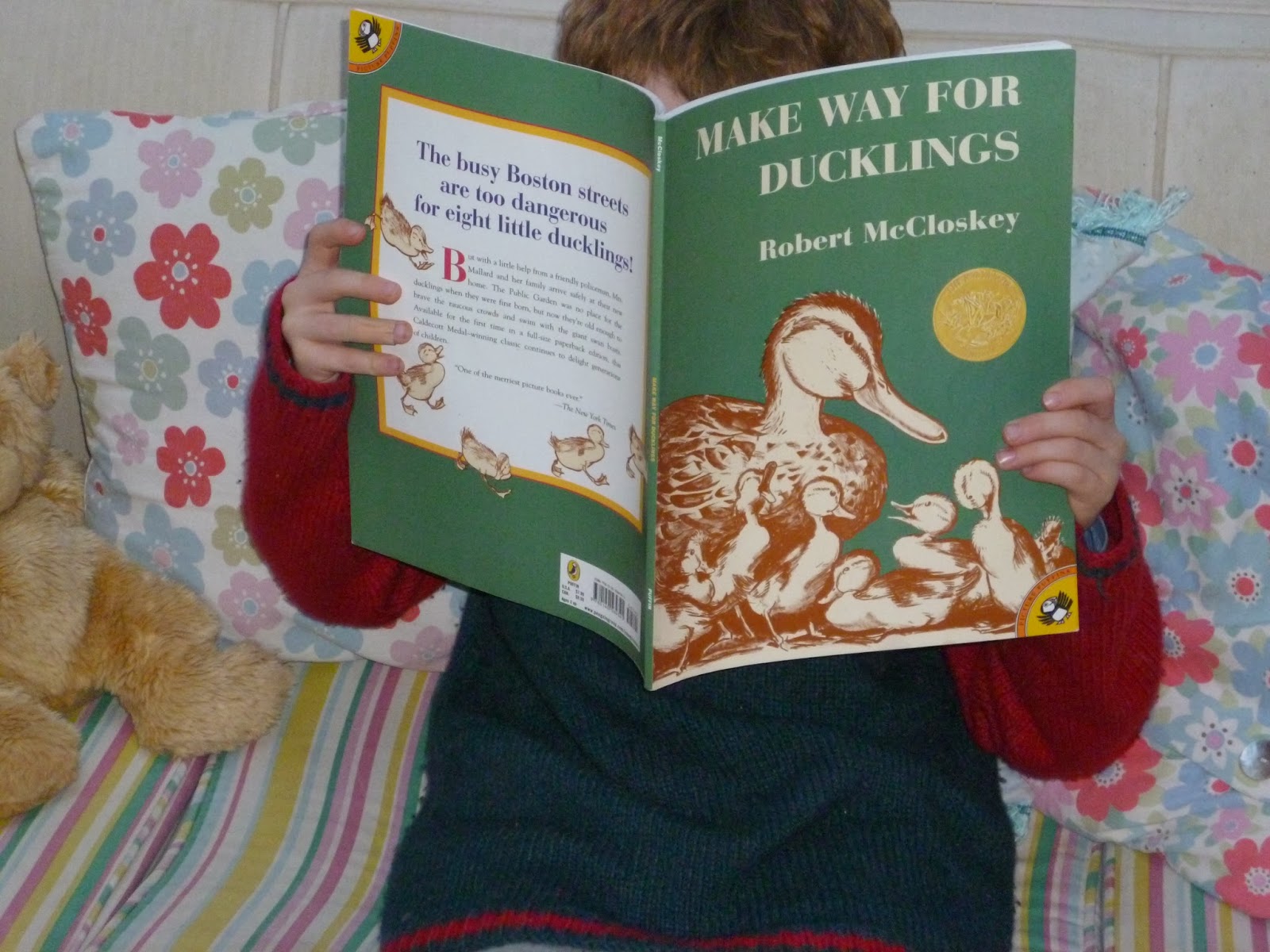
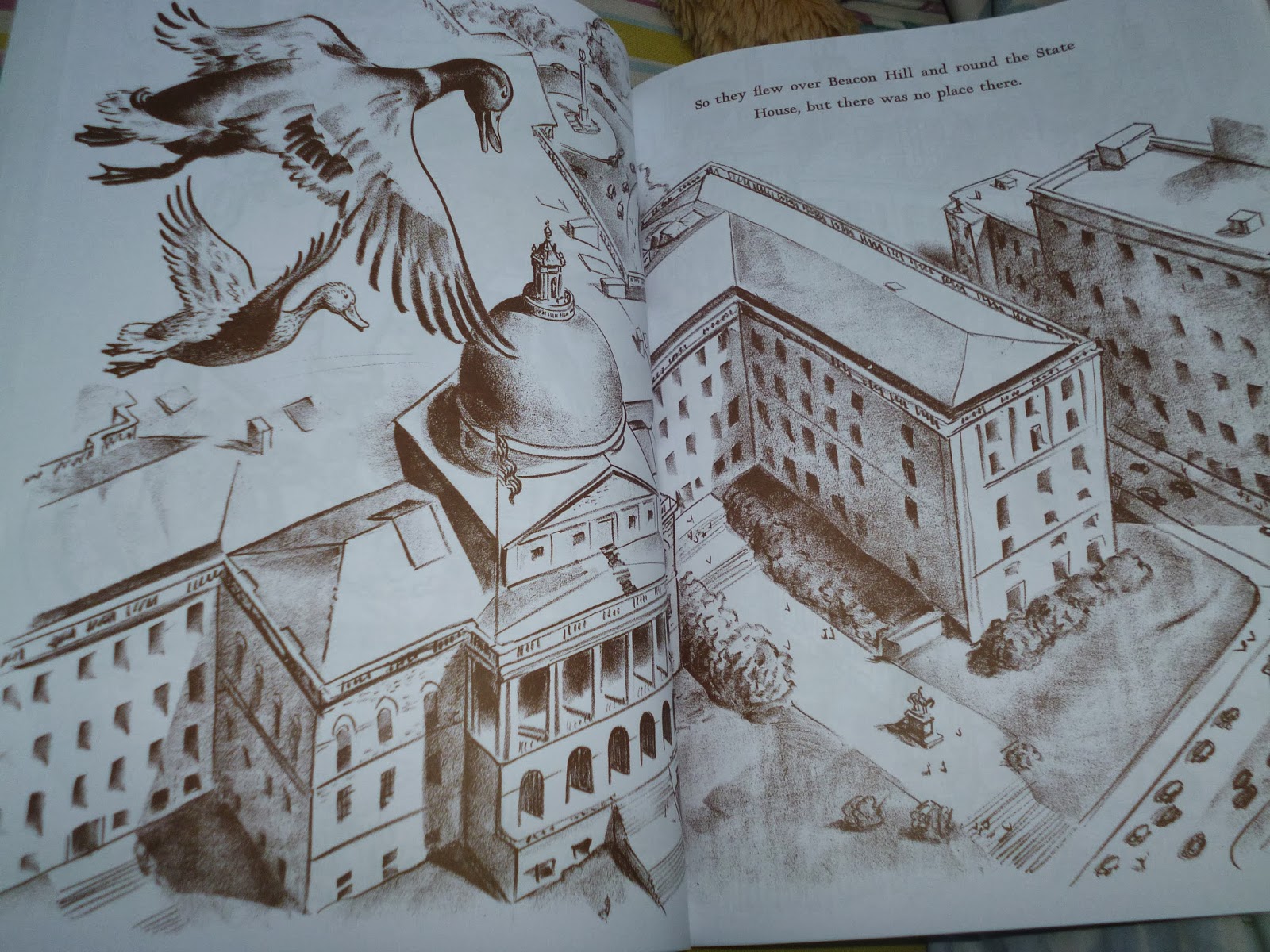
Make Way For Ducklings


In the mid-nineties I worked in the Globe Corner Bookstore in Boston. It was a bit of a landmark, having formerly been the Corner Bookstore, which was a well known publishing house and where Charles Dickens used to meet up with Ralph Waldo Emerson and Henry Wadsworth Longfellow and Nathaniel Hawthorne.

The ground floor was devoted to childrens books and information about Boston and the first floor to travel guides and maps. One of the top sellers on the ground floor was the great Make Way For Ducklings by Robert McCloskey. Actually, this book is where my love of American childrens literature began. One way of  "familiarising myself with the merchandise" was reading the books. Another reason I love this one is because I can say to my kids "There I am!" peering out the window of the Corner Bookstore because that is what I did a lot of the time, when I was whiling away the day.
Its a wonderful book, and not just for those who might be interested in Boston (although if you know the city it is particularly nice). My boys like it for the pictures of children playing, the determination of the ducks and the satisfying ending. Its a pretty big format, which suits it, although I'd recommend the hardback for reading comfort. Like a lot of these older books (this one was published in 1941) this one is criminally cheap and would make a really special present for anyone aged three to six.


The Book about Moomin, Mymble and Little My

Tove Jansson wrote her first Moomintroll book in 1945. Its called The Moomins and the Great Flood and deserves a post of its own. Actually all her books do. They are not only beautiful but so gentle and thought provoking and wondrous and actually, very cool. This one The Book about Moomin, Mymble and Little My is from a series of three recently re issued by Sort Of Books. It features Janssons art and words, but translated by the English poet Sophie Hannah. She did a great job. Its a rhyming story about Moomin and his friends Mymble and her sister Little My. They all feature in the Moomin series for older kids (age eight to ten) too.
In this, Moomin sets off on a journey to get milk for his mother, and has quite a few adventures in the process. There is a lot of text on each page for smaller kids, I just read two lines to per page to my two year old, so I suppose four is the ideal age. Also, there is a little window cut in every second page, which is a little delicate, so that too is'nt ideal for toddlers. But just look at these illustrations. I know I could look at them all day long.


P.s. I first read about this book on Vintage childrens books my kid loves and Julias bookbag.